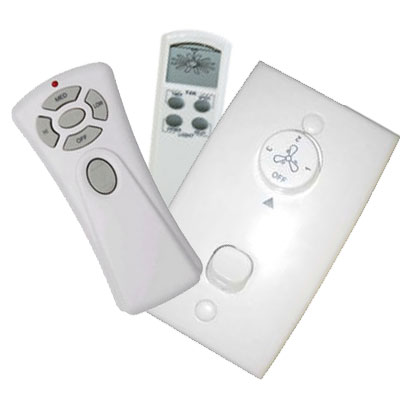
To Remote Or Not To Remote

Ceiling-Fans-with-remote

One of the most obvious differences between ceiling fans in the type of control they use. Deciding which type of control you would like isn’t always easy and there are a few things to keep in mind before you make your choice.

Ceiling fans have three types of controls:

  • Remote controls.
  • Wall control
  • Pull cord: The original method was to pull a cord hanging from the motor. It turns the fan on and off and sometimes change speeds. This option is still available in some traditionally styled fans.

Generally when you buy a fan, it will come with just one of these control methods included, but many will have the option of using another method instead at an extra cost. Not all fans have the option of a remote control, but most do. Some will have it as the standard form of control. Others will have a pull cord or wall control and offer the remote as an optional extra.

Ceiling fans with remotes offer many advantages, but they are not the right solution for everyone. Sometimes they are necessary, sometimes they are more convenient, and sometimes you are better off without them!

When you need to have a remote control

There are cases where installing a fan will only be possible with a remote control.  You may not have access to run the wiring through the ceiling and down the wall to install a wall control.  This is common for apartments with another floor above them, where there is no access the wiring in the ceiling. However, there is a light in the room, so you can replace the light with a fan and light, and use a remote option to control both.

You will also need a remote control is if it is the only option for the fan model you choose. This is especially true for DC fans – which currently are only available with remote controls. So you might solve the problem of whether to use a remote when you choose your ceiling fan.

When a remote control is optional

If accessing the wiring is not a problem, you may still find a remote more convenient:

  • In a bedroom, a remote will allow you to turn the fan on and off from bed.
  • If you have more than one fan: In a large space (such as a living room or restaurant) where you  want to your fans simultaneously (ie they all turn on together). In this case, you can install radio frequency remotes, set them all on the same frequency. They will all turn on and on to the same speed from the one remote control handset.

When you are better off avoiding a remote control!

There are some cases where you may be better off avoiding a remote control for your ceiling fan:

  • When you are on a limited budget. Remotes will usually add about $50-$100 to the cost of the fan.
  • If you think the remote may get lost. This is sometimes a concern for people who have young children or pets in the house. You can get around this by choosing a model which comes with a cradle for the remote.
  • If you don’t want to avoid replacing batteries. If you do not want to deal with flat batteries in the remote, a wall control or pull cord is a better option.
  • Finally, remotes will break down over time and need to be replaced. Pull cords and wall controls are more durable ( unless some external factors causes damage to them) so they need less maintenance.
  • If you are noise sensitive. Most remote controls create a beep sound to indicate that the handset and receiver are communicating properly. This also happens when the isolation switch is turned on, to indicate that power is going to the receiver. It’s possible to switch this off on some remotes, so if something you’re concerned about please contact us for suggestions.

So it’s really up to you if you decide ‘to remote or not to remote’. It depends on your situation, your preferences, and your budget!
Read More

Fan blades: It’s not just size that counts!

A fan blade is a fan blade, right? Yes, but there is a bit more science to it. There are many factors which affect how effective a blade (or to be more precise, a set of blades) will be in moving air.

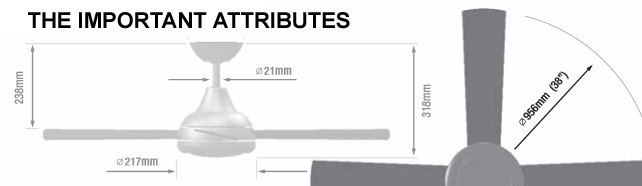
fan-attributes-blog

Size (Length) – The longer the blades are, the larger area they will cover. As a general rule, you can expect to feel the air a metre further than the diameter of the fan blades. The standard size you will find today is 52” (1.3m diameter), and this is a good size for most situations. However, there are large ceiling fans which go up to a 2m diameter. And of course, for very small areas, you might only need a small fan, and these are available too!

Weight/Material – As you can imagine, a heavier blade will move more air than a lighter blade. Most blades do not vary very much in weight. However, there are some fans which use very light materials, such as real palm leaves, to create a tropical look. These fans will still move air, but less than fans with plastic, timber or metal blades. Just a matter of balancing how much you want the fan for looks and how much you need it to move air!

Shape – A blade which is too wide will be less effective as it will create too much weight on the motor and this will mean the fan will not reach optimum speed. As a result, you will get less air movement.

Pitch – A decent pitch is very important to moving air. A blade which is at a flat angle won’t push any air down. Of course, you don’t want to take it to extremes because a blade with too much pitch won’t be effective either! A decent pitch is normally between 12 and 22degrees.

Quantity – Contrary to popular opinion, when it comes to ceiling fans blades, less equals more. All other things being equal, a fan with 3 blades will move more air than a fan with 4 or 5 blades.

So how do I choose?! In reality, you won’t get a lot of choice because most of these factors are fixed. The manufacturers take these factors into account and try to balance function and aesthetics. The next best option is to talk to a ceiling fans expert and explain what you need to them! You can discuss your needs with our friendly and knowledgeable sales staff on the phone and have your order shipped to you. It couldn’t be easier!

Read More

Get your Ceiling Fan into Winter Gear

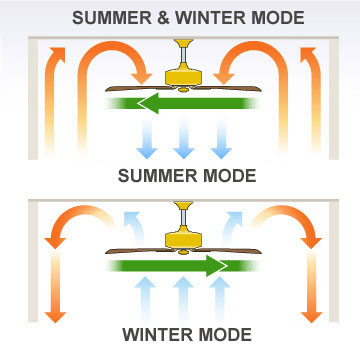
Did you know your fan probably has a winter setting? This simply means that it rotates clockwise instead of anti-clockwise like in summer. This has the effect of pulling air up instead of pushing air down. So why would this help you? Well, by pushing the air that is below up to the ceiling, the hotter air, which is sitting up above the ceiling fan, gets circulated down. Hence, you keep the hot air down instead of losing it up near the ceiling. This can be especially handy for those with very high ceilings.

You only need to run the fan on low speed, and you shouldn’t really feel the breeze – only very slightly if you do. By making better use of this hot air, you can keep your heater settings on lower, and therefore save on energy and consequently quite a few dollars! Fans only use minimal electricity to run on low speed, most around 15-20watts, which is the same as an energy saving light bulb!

To find your winter/summer setting, simply check the body of the motor of the fan. There is usually a switch on the motor and it will often have a sticker labeling which setting is summer and which is winter. Alternatively, if you have a DC motor fan, your summer/winter reverse switch will probably be on the remote control.

If you are not sure if the ceiling fan you are interested in has this winter setting option, you will usually find this information in the “Additional Information” tab on the individual product pages. There should be a line headed “Reversible” and there it will say whether it is “reversible by remote”, or “reversible by motor”. If it is reversible by remote, this means that you can select to operate the fan in reverse (winter mode) from a control on your remote. If it is reversible from the motor, there is likely a switch on the motor to change to winter mode.

Social: Google+

Read More

How to Choose Outdoor Ceiling Fans

Outdoor ceiling fans can provide much needed cooling when outside. We have a great range of outdoor ceiling fans that match with your home’s architecture from traditional styles to modern and tropical designs.

With the heat of the Australian summer, outdoor areas are hugely popular in both traditional and modern homes. Alfresco / patio areas are being built as standard in new homes as well as being top on the list for renovations.

How do you know what fans can be installed outdoors?

The majority of ceiling fans are designed for indoor use, so they cannot be used in outdoor areas. Even if you install your fan in an undercover area with only one wall open to the outdoors, moisture will still find its way into your fan and cause damage.

So when looking for a fan for the outdoors, you will need to firstly assess the environment around you.

Ask yourself:
1. Do I live in a coastal area?
2. Will the fan be installed where it may be exposed to water reaching it?

Take great attention to the IP rating of a fan as it is an internationally recognised rating. These ratings are attributed to whether the fan can withstand water ingress and/or water penetration.

IP44 – suitable for wet locations, tested for water splashing against the enclosure from any direction.

Damp Rated – suitable for fully covered outdoor areas.

316 Stainless Steel – suitable for fully covered outdoor areas.

Coastal – not all outdoor fans are resistant to salt spray, so if you live in a coastal area, make sure your fan is coastal rated.

Materials For Outdoors

You will need all weather resistant material for your outdoor ceiling fan. While timber blades will absorb moisture, all weather plastic blades and stainless steel blades are what to look for.


Disclaimer – please note that all advise and information provided on this website is for guidance only and may not take into consideration your specific environment and other factors.

Read More